How to transpose a guitar chord sheet for your voice
Transposing a song means moving every chord by the same musical interval. The chord qualities and progression functions stay intact: a major chord remains major, a minor chord remains minor, and a slash bass moves with its chord. The goal is usually to place the melody in a comfortable vocal range, not merely to find easier guitar shapes.
A chord sheet alone cannot reveal the melody’s highest and lowest notes. Singers should supply the actual sung range of the song, then try complete phrases in the candidate key before committing to it.
What matters most
- Find or declare the original key before transposing.
- Move every chord by the same number of semitones, including slash basses.
- Choose the vocal key first and solve guitar comfort with voicings or a capo afterward.
- Test sustained high notes and the lowest verse, not just one chorus line.
Understand the musical decision
Use melody evidence, not chord names, for vocal fit
Two songs in C major can demand completely different voices. One melody may stay between G3 and C5 while another falls to C3. Record the song’s lowest and highest sung notes in its original key, along with your comfortable low and high notes. The difference between those endpoints shows how far the melody can move before it leaves your useful range.
Comfort is more than technically reaching a pitch. Leave room around the extremes for tone, volume, and repeated notes. Barre None treats less than two semitones of headroom as a marginal fit so the recommendation does not pretend that a barely reachable note is effortless.
Preserve the progression while changing key
A C–Am–F–G progression is I–vi–IV–V in C major. Moving it down two semitones produces B♭–Gm–E♭–F, which is still I–vi–IV–V. Transpose symbols, not lyric text, and verify that accidentals use a readable spelling for the destination key.
For a slash chord such as C/E, transpose both parts. Moving down two semitones gives B♭/D. Leaving the bass note behind changes the harmony and can break a written bass line.
Separate vocal key from guitar shapes
After choosing the sounding key, compare voicings and capo positions. If B-flat suits the singer, capo 3 with G shapes can keep the song in B-flat while making it comfortable on guitar. Do not raise the melody again after applying the capo; the capo recommendation already accounts for the difference between sounding chords and shapes.
Example: move a C-major song down for the singer
The original progression is C–Am–F–G. Its melody spans D3–E4, while the singer is most comfortable from B2 to D4.
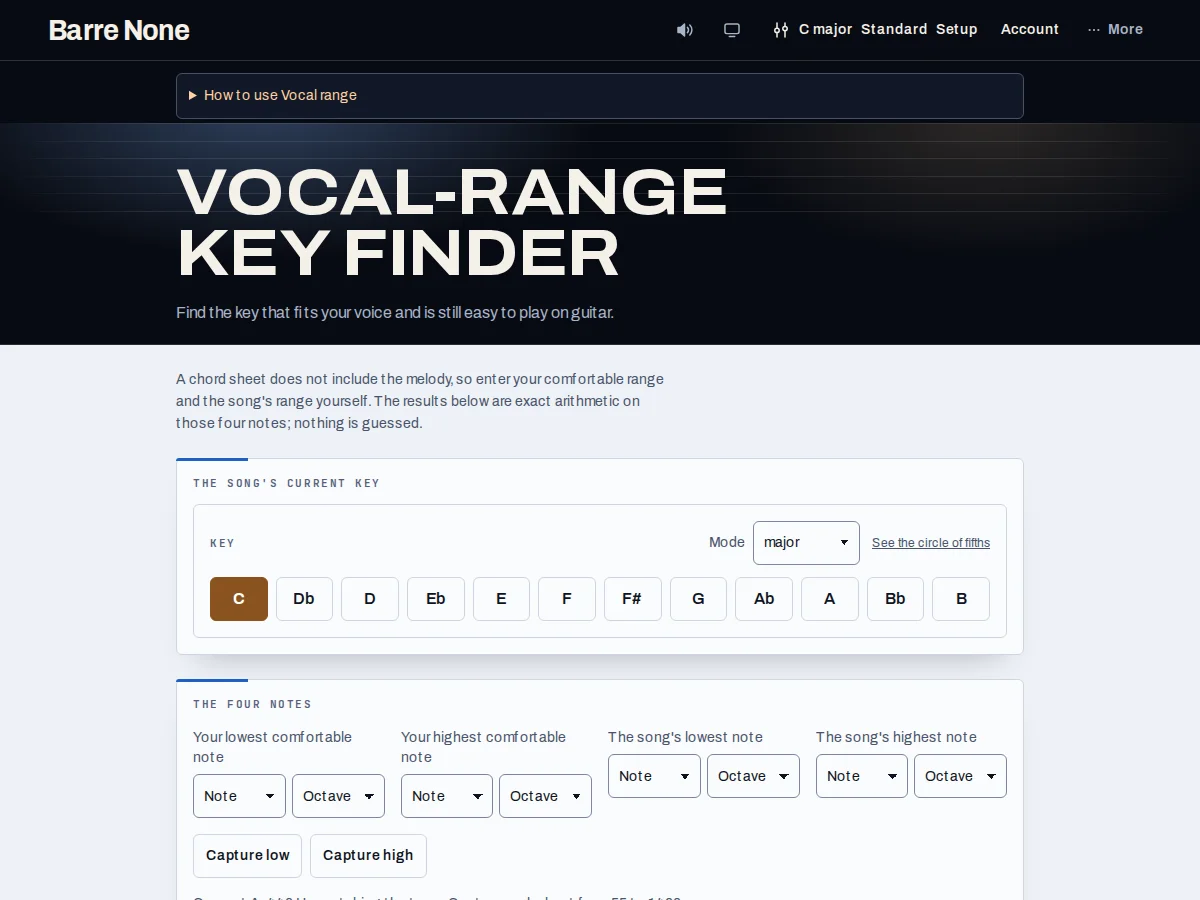
- Enter the singer’s comfortable range and the song’s original sung range in Vocal range.
- Compare the ranked keys and audition the melody endpoints, not just the chords.
- Choose B-flat major, two semitones below C major.
- Transpose the sheet to B♭–Gm–E♭–F, then compare direct shapes with capo 3 using G–Em–C–D shapes.
Result: The melody becomes C3–D4, leaving the sustained top inside the singer’s comfortable range. The progression remains I–vi–IV–V, and the guitarist can choose direct B-flat shapes or capo 3 without changing what the audience hears.