DADGAD guitar chords and progressions: a practical start
DADGAD tuning lowers the first, second, and sixth strings of standard tuning to create D–A–D–G–A–D. The open strings form a suspended D sound: they contain D, G, and A but no F-sharp or F-natural, so they do not decide whether the harmony is D major or D minor by themselves.
That ambiguity is the tuning’s strength. Open D and A strings can ring across several chords while one or two fretted notes establish the chord quality. The result can sound wide and connected, but only if unwanted drones are controlled.
What matters most
- Treat DADGAD as its own tuning; standard-tuning fret patterns no longer name the same notes.
- The open strings imply Dsus4, not a complete D-major or D-minor triad.
- Add F-sharp for D major and F-natural for D minor.
- Let drones ring when they belong to the chord, and mute them when they blur the harmony.
Understand the musical decision
Know what the open strings contribute
Three open D strings and two open A strings reinforce the tonic and fifth. The open G supplies the suspended fourth. Over a D chord this creates the characteristic suspended color; over G it can reinforce the root; over A it can create an A7sus sound. Those are useful colors, not automatic permission to leave every string open.
When a progression moves outside D-centered harmony, check every drone. A ringing D can become a seventh, suspension, or dissonance depending on the chord. Decide whether that color supports the arrangement rather than accepting it by accident.
Build chords from notes instead of memorized grips
Start with the notes a chord requires, then look for a compact voicing on D–A–D–G–A–D. A D-major chord needs D, F-sharp, and A; the open tuning already supplies D and A, so only F-sharp is required to establish major. G major needs G, B, and D, while A major needs A, C-sharp, and E.
Duplicating the root or fifth is normal. If a required third is missing, the result may sound suspended or ambiguous even when the root is obvious. Barre None labels the notes in each generated voicing so you can see what is present rather than trusting a shape name alone.
Begin with D-centered progressions
Progressions in D major or D Mixolydian make immediate use of the open-string center. Try I–IV–V in D major, D–G–A, and listen to how the drones connect the changes. Then try D–C–G for a Mixolydian color. Slow the changes down and mute any open string that obscures the chord’s defining note.
- Retune carefully and verify both A3 strings; unison strings should agree.
- Use a tuner that understands DADGAD rather than aiming at standard-tuning targets.
- Save the tuning in shared links so another player sees the intended diagrams.
Example: hear I–IV–V in DADGAD
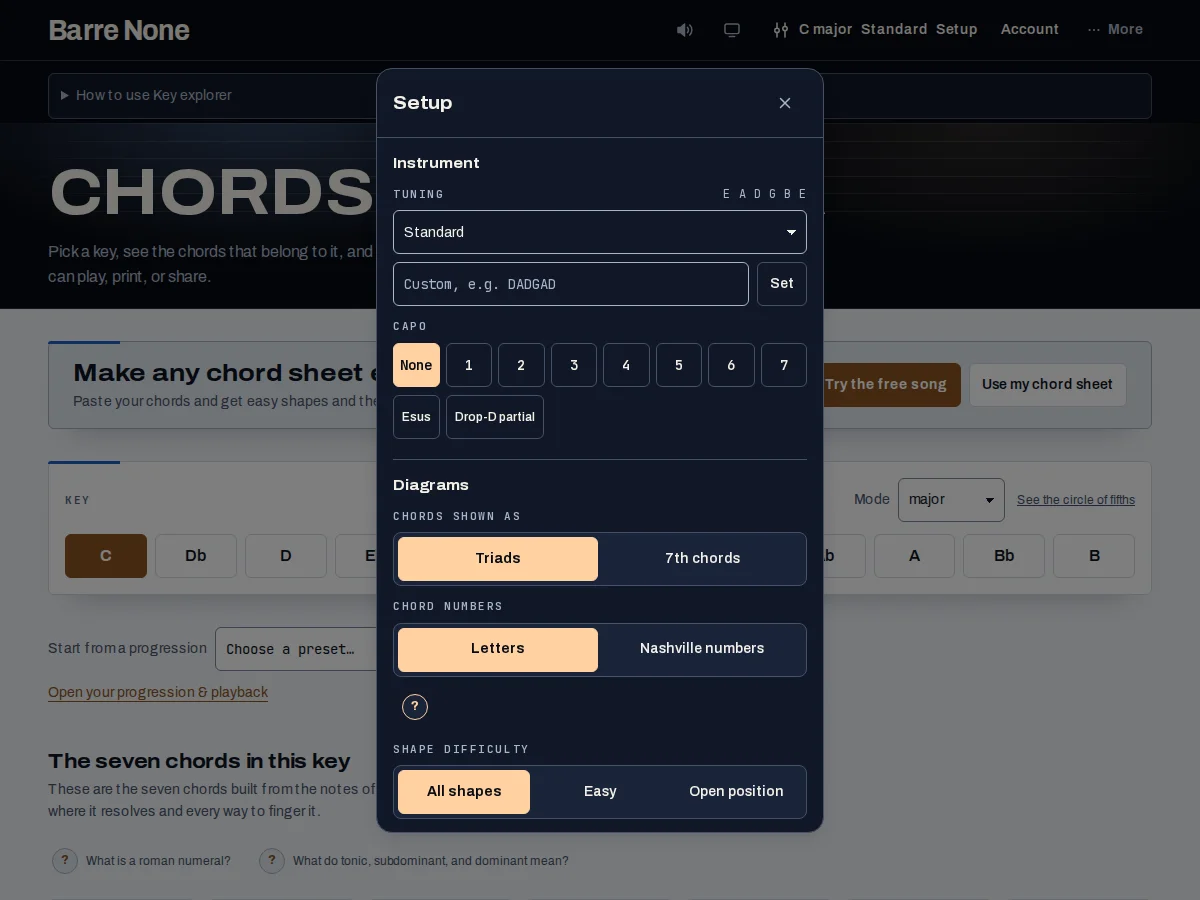
Set the tuning to DADGAD and the key to D major.
- Open the D-major key and inspect the generated D, G, and A voicings.
- Confirm that each selected shape contains its required third: F♯ for D, B for G, and C♯ for A.
- Build D–G–A–D and play it slowly while listening to the repeated D and A drones.
- Compare alternate voicings and mute a drone whenever it hides the chord change.
Result: The progression keeps a continuous D-centered resonance while its thirds make each harmonic function audible. You learn why a voicing works instead of treating DADGAD as a collection of unexplained grips.