How to identify a guitar chord from fret numbers
A fingering is not a chord name by itself. First translate each sounding string into a note using the guitar’s tuning and capo, then remove duplicate pitch classes and identify the interval pattern. The lowest sounding note matters because it may turn a root-position chord into an inversion or slash chord.
More than one name can describe the same collection of notes. Context decides which label is useful: the key, the bass movement, and the chords around it can make one interpretation clearer than another.
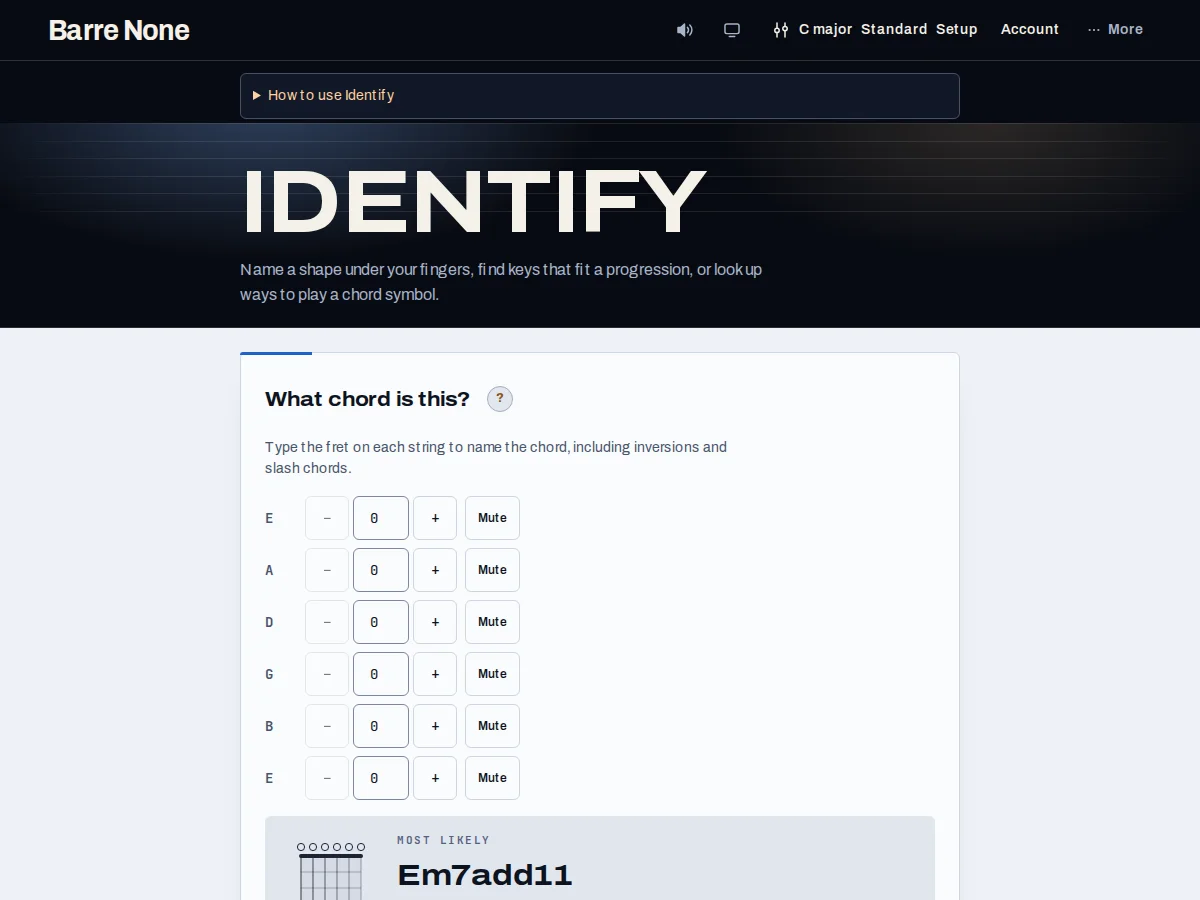
What matters most
- Enter strings from the lowest-pitched string to the highest.
- Use 0 for an open string and Mute for a string that does not sound.
- Count frets relative to the capo in Barre None.
- Check tuning before identifying; the same fret pattern produces different notes in another tuning.
Understand the musical decision
Translate the shape into notes
In standard tuning the open strings are E2, A2, D3, G3, B3, and E4. Each fret raises a string by one semitone. The common shape x–3–2–0–1–0 therefore gives C3, E3, G3, C4, and E4 after the muted low E is ignored. Reducing octaves leaves C, E, and G: the notes of C major.
With a capo, Barre None treats entered fret numbers as distances above the capo. An entered 0 means the string rings from the capo, not from the physical nut. This keeps displayed shapes, playback, and identification consistent.
Use the bass note to name inversions
If C, E, and G are present with E as the lowest note, C/E is usually the clearest name. The pitch set is still a C-major triad, but the slash communicates the bass line. When the lowest note is not part of the simplest chord, the result may be a more extended chord or a deliberate non-chord bass.
Why several matches can be correct
A small pitch set may omit a root, fifth, or color tone. C, E, A can be read as Am/C or as a rootless Fmaj7 fragment depending on context. A chord finder should show plausible matches rather than invent certainty. Listen to the surrounding harmony and prefer the name that explains both the bass and the chord’s function.
- Verify every string that should be muted really is silent.
- Include duplicated notes; they do not change the chord class but can clarify the voicing.
- If no useful match appears, recheck the tuning, capo, and string order.
Example: identify x–3–2–0–1–0
Use standard E–A–D–G–B–E tuning with no capo.
- Enter Mute, 3, 2, 0, 1, 0 from the lowest string to the highest.
- Read the sounding notes C, E, G, C, and E.
- Reduce duplicate octaves to the pitch classes C, E, and G.
- Confirm that C is the lowest sounding note and that the intervals above it form a major triad.
Result: The direct name is C major. If the same C–E–G notes were voiced with E in the bass, the more informative label would be C/E.